

In programming, a data type consists of a set of values and a set of operations that can be performed on those values. A literal is the way a value of a data type looks to a programmer. The programmer can use a literal in a program to mention a data value.

Strings
In Python, a string literal is a sequence of characters enclosed in single or double quotation marks. Double-quoted strings are handy for composing strings that contain single quotation marks or apostrophes.
Some examples of string literals include:
- an empty string- “”
- spaces- ” “
- sentences with punctuation- “Here’s some punctuation!”
- single words- “hello”
Escape sequences
Escape sequences are the way Python expresses special characters, such as the tab, the newline, and the backspace (delete key), as literals.
Some examples of escape sequences include:
- Backspace- \b
- Newline- \n
- Horizontal Tab- \t
- The \ character- \\
- Single quotation mark- \’
- Double quotation mark- \”
String Concatenation
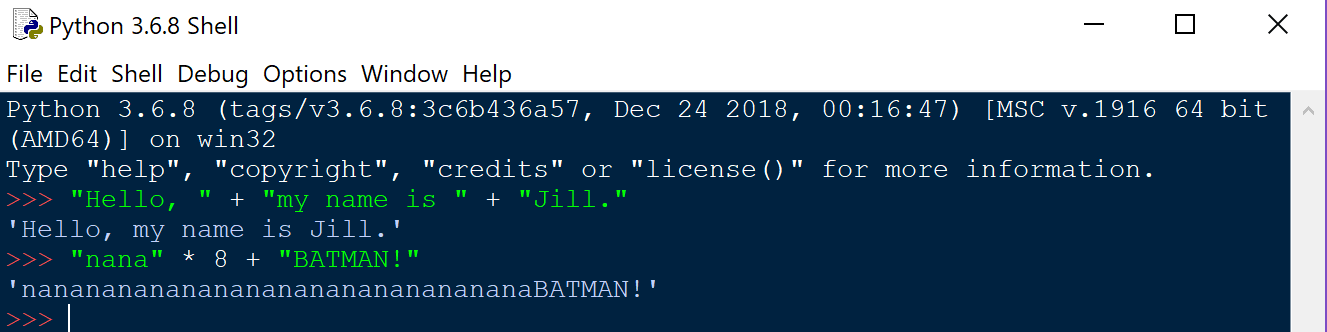
You can join two or more strings to form a new string using the concatenation operator +.
 Programming with Python