
A list is a sequence of data values called items or elements. An item can be any type of data. The logical structure of a list is similar to the structure of a string. Each of the items in a list is ordered by position. Like a character in a string, each item in a list has a unique index that specifies its position. The index of the first item is 0, and the index of the last item is the length of the list minus 1.
A list in Python is comparable to an array in Perl and Java.
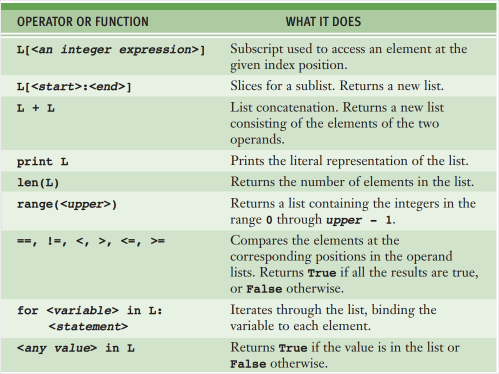
Before modifying a list with any functions or operations, you must define a list. This defines it and sets the length and data values. The following is a table of operators and functions commonly used with lists.
There is one huge difference between a string and a list. A string is immutable, its structure and contents cannot be changed. A list is mutable, meaning it can be changed and modified. At any point, elements can be inserted, removed, or replaced. The list itself maintains its identity, but its state— its length and its contents– can change.
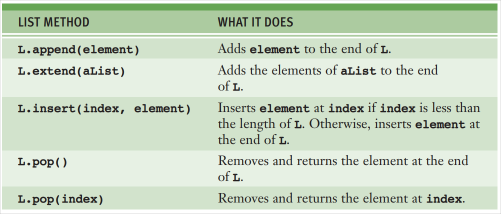
Here is a list of methods used for changing the state of a list.
 Programming with Python